-
islamoCautiousness
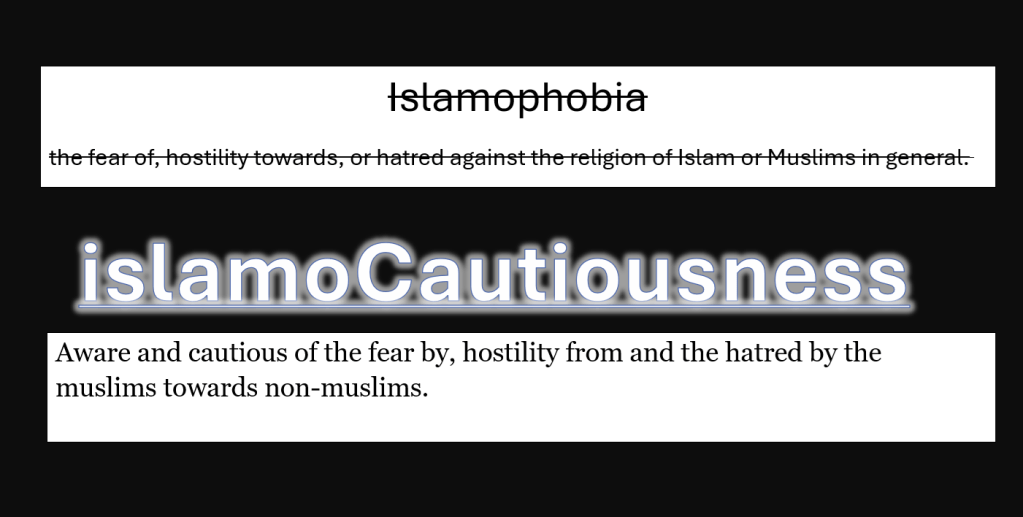
Just like any other religion, islam is a threat and is arguably the biggest threat in the world right now. Then, there is the word islamophobia which gives the impression that islam is an ordinary thought but being cautious of islam is a phobia. But in reality, islam is arguably the biggest danger out there and being cautious towards danger is not a phobia – just like being cautious of nazism is not a phobia. Thus, we argue, we shall use the word “islamoCautiousness” instead of islamophobia.
Have you ever been accused of being phobic when actually you are cautious of people that aims to subjugate you, to kill you, to eradicate you? That is how the word islamophobia has been coined.
When muslims have enough power, muslims always try to suppress others or destroy others. They no need introduction on this matter: Every year in England for example, there are dozens of muslims protesting demanding that the UK shall abolish secularism and everyone be forced to live according to sharia laws. And this happens in most European Union countries where muslims have significant population. Here is a report from the European Parliament:

In case of the image going missing, here is the text:
Growth of Islamic fundamentalism, spread of Sharia in Europe and protection of EU citizens
9.10.2017
Question for written answer E-006320-17
to the Commission
Rule 130
Mara Bizzotto (ENF)In Belgium and throughout Europe the number of Muslim communities is on the rise, owing to the arrival en masse of Muslim immigrants from third countries. The growth of the Muslim population in European towns and cities has facilitated the dissemination of the precepts of Islamic fundamentalism and Sharia, the Islamic law which does not recognise European values such as democracy and gender equality.
Islamic fundamentalism is a grave threat for Europe, as demonstrated by the increasingly frequent terrorist attacks against European citizens, the latest of which in Barcelona on 17 August 2017.
Groups of Islamic extremists who want Sharia law to be imposed in Europe are increasingly numerous and violent, such as the group ‘Sharia for Belgium’ of the religious leader Fouad Belkacem, alias Abu Imran, according to whom the Islamic community will soon be laying down its own rules in Brussels.
In view of internal radicalisation issues and of the July 2017 report by the Commission’s Radicalisation Awareness Network (RAN), according to which some 5 000 European foreign fighters have left for Syria, 30% of whom have already returned to the EU, can the Commission answer the following questions:
- —What action does it intend to take to guarantee security in the EU, given the escalation of Islamic fundamentalism in European cities?
- —Does it not think it would be useful to monitor the activity of Islamic fundamentalist groups that are active in Europe, to prevent the spread of religious intolerance and hatred of European civilisation?
But that is not all I would want to highlight here:
- muslims try to suppress the homosexuals.
- muslims try to suppress free speech when the free speech hurts islam.
- muslims try to suppress cohabitation.
- muslims try to suppress pork and alcohol consumption.
- muslims try to suppress the celebration of both secular and non-islamic holidays like Christmas.
- muslims are free to state that they would never marry or befriend non-muslims but when a non-muslim says the same on a muslim, s/he is immediately accused of islamophobia.
I can list so many other things but no need: One thing is clear, if anyone is stigmatized as “islamophob”, be rest assured that that person is wary and cautious of the dangers by islam and muslims.
Be islamoCautious and proud. Manifest your islamoCautiousness!
We, Outspoken Atheism, are an islamoCautious movement that aims to repel the dangers of islam.
-
Neotheist hoaxes 5: “Jesus Mythicism Is Amateurish”
While even some Jesus historicist scholars like Bart Ehrman do grant that Jesus mythicism is a worthy case, neotheists has a widespread view to decry the Christ Myth Theory. I call it “Jesus Conspiracism: Convinient approach to discredit and de-legitimize the idea of questioning Jesus’ historicity.” Jesus conspiracism among internet neotheists is the result of expert charlatans running discreditory attitude towards mythicsm. In this essay, you will see quotes from historicist scholars about how strong Mythicist arguments are and then you will see neotheist scholars bashing mythicism as if mythicism is some sort of theistic belief. Moreover, historicist scholars even admit that Mythicism is deliberately ignored so that it is seen as worthless.
Maurice Casey for example, states (2014, 243) that mythicism “has not been produced by anyone or anything with any reasonable relationship to critical scholarship”. Not only that, he goes on to state the following as well:
It belongs in the fantasy lives of people who used to be fundamentalist Christians. They did not believe in critical scholarship then, and they do not do so now. I cannot find any evidence that any of them have adequate professional qualifications.
Unlike Maurice Casey (and his victims, neotheists), Bart Ehrman, Robert Van Voorst, Archibald Robertson and alike not only grants that Mythicism is a worthy case, but admits that neotheist scholars ignore it deliberately (Ehrman 2012, chapter: On Taking Mythicists Seriously):
IT IS FAIR TO say that mythicists as a group, and as individuals, are not taken seriously by the vast majority of scholars in the fields of New Testament, early Christianity, ancient history, and theology. This is widely recognized, to their chagrin, by mythicists themselves. Archibald
Robertson, in one of the classic works in the field, says with good reason, “The mythicist…does not get fair play from professional theologians. They either meet him with a conspiracy of silence or, if that is impossible, treat him as an amateur whose lack of academic status…robs his opinion of any value. Such treatment naturally makes the mythicist bellicose.”Here, Ehrman notes that mythicists are not taken seriously and then goes on to quote Archibald Robertson stating that mythicists does not get fair play, they are treated as if they are amateurs. Then, in the following paragraph, Ehrmans states the following:
Established scholars continue to be dismissive, and mythicists as a rule are vocal in their objections. As mentioned, the one mythicist within the vision of many New Testament scholars is G. A. Wells. In the massive and justly acclaimed four-volume study of the historical Jesus by one of the leading scholars in the field, John Meier, Wells and his views are peremptorily dismissed in a single sentence: “Wells’s book, which builds its arguments on these and similar unsubstantiated claims, may be allowed to stand as a representative of the whole type of popular Jesus book that I do not bother to consider in detail.”
Even books that one might expect to take up the issue of Jesus’s existence simply leave it alone. A case in point is the volume I Believe in the Historical Jesus by British New Testament specialist I. Howard Marshall. The title gives one a glimmer of hope that at least some attention will be paid to whether there actually was a historical Jesus, but the book presents only Marshall’s theologically conservative views of the historical Jesus. Marshall mentions only one mythicist, Wells, disposing of him in a single paragraph with the statement that no scholar in the field finds his views persuasive since the abundant Gospel sources, based on a
variety of oral traditions, show that Jesus must have existed.above excerpts are from the same chapter of Ehrman’s book. After this paragraphs, Ehrman goes on to state “I think Wells—and Price, and several other mythicists—do deserve to be taken seriously”. Note that, both Ehrman and Archibald Robertson are Jesus historicists, yet they admit that other scholars dismiss mythicism.
Van Voorst was a Christian theologian and an expert at New Testament studies. In his book named “Jesus Outside the New Testament”, Voorst iterates what these neotheists do (2000, 6-16):
This is the controversial question, Did Jesus really exist? Some readers may be surprised or shocked that many books and essays — by my count, over one hundred — in the past two hundred years have fervently denied the very existence of Jesus. Contemporary New Testament scholars have typically viewed their arguments as so weak or bizarre that they relegate them to footnotes, or often ignore them completely. Thus, students of the New Testament are often unfamiliar with them.
If you read on, Voorst lists several reasons of New Testament scholars rejecting nonexistence hypothesis [of George A. Wells.] Among some content-related reasons, Voorst states the following (2000, 15):
Wells and others seem to have advanced the nonhistoricity hypothesis not for objective reasons, but for highly tendentious, antireligious purposes. It has been a weapon of those who oppose the Christian faith in almost any form, from radical Deists, to Freethought advocates, to radical secular humanists and activist atheists like Madalyn Murray O’Hair.
While Voorst lists some scholarly reasons for rejecting mythicism, he does not deny that mythicism being anti-religious is also a reason mythicists are dismissed, ignored, bashed.
The 15th chapter of Dan Barker’s book named “Godless: How an Evangelical Preacher Became One of America’s Leading Atheists”, Barker recalls his evangelist years and states that they used to dismiss the possibility of Jesus never existing as “a tiny fringe of quacks and atheists.” Then, Barker recalls that they were offered a course dedicated to the book of Romans, another one on Jewish wisdom when he was a university student at religious studies but historicity of Jesus was not remotely taught. Do you see this systematic ignorance and delegitimasation?
Rafael Lataster similarly expressed (2015, chapter: Conclusion) this approach:
But look at what Casey did. Look at what Ehrman and the others do. These prominent historicists strangely and illogically appeal to the majority, appeal to authority, appeal to possibility, and, worst of all, appeal to innumerable sources that don’t even exist, in order to prove something that is supposedly very obvious. If we argued like they do, we would be overlooked (well, more than we already are), and rightly so.
but that is not all. Here is what Lataster states further (which can be an explicit and literal corraboration of this essay):
Instead, Carrier is criticised. Not overwhelmingly, however. Scholars like
Avalos and myself are appreciative of his efforts. Few historicist scholars
seem to have properly engaged with his work here, leaving amateurs to
discredit him.As you can see, neotheists dismiss Mythicists so that they are discredited in the eyes of neotheists. If you recall, Casey bashed Mythicists stating that mythicists do not accept scholarship and they lack professional qualification. That is a blatant lie. Van Voorst narrates the history of this mythicist view and lists credible academics working on it. Let me iterate some names and their qualifications on my own:
- Constantin François de Volney’nin çalışmalarıdır. Expert at ancient languages, one of founders and pioneers of Egyptology. Spent years in Egypt and Palestine, working on their history. Has several works on the history of religions and the philosophy of history.
- Charles Fracçois Dupis
- Bruno Bauer. A Christian theologian. Fired from his university job for his works on Jesus Mythicism and his status of professorship has been stripped from him.
- John Mackinnon Robertson and Arthur Drews were also proponents of Mythicism. You can just google them and see their qualifications.
- Earl Doherty: Though he describes himself as an amateur, Doherty is master of classics. Ehrman touts him as “very good “read widely and has a gooddeal of knowledge at his disposal.”
- Robert Price: PHD in theology, PHD in New Testament studies. Ex-evangelist. Knows ancient Greek, as well as being excellent at history.
- Thomas Thompson: has degree in Biblical studies. Expert at Jewish Tanakh (Old testament), expert at Hebrew.
- Richard Carrier: PHD in history, expert at Classics. Actually, needs no introduction.
- Tom Harpur: has worked as professor of New Testament studies and Theology. Expert at Greek and Latin.
- George Albert Wells: Needs no introduction. Widely considered the best representative of Mythicism. Ehrman and Voorst praises him.
- Dorothy Murdock: Has degree in classics, professor of Greek in Greece.
Despite all such names with qualifications, Casey and neotheists allege that Mythicism is a work by amateurs, unqualified people. You can see its fruits in the internet: Jesus Mythicism is bashed, treated like young earth creationism or intelligent design are treated. We can see many examples of it:
- Here is a Quora thread/question where it is asked if Jesus Mythicism is like Holocaust denial: https://www.quora.com/Are-atheists-who-promote-the-crackpot-theory-of-Jesus-mythicism-debunked-by-actual-scholars-of-Early-Christianity-as-morally-bankrupted-as-Holocaust-denialists
- Randal Rauser’s blog for example quotes people bashing Jesus Mythicism: https://randalrauser.com/2016/06/jesus-mythicism-reflections-on-the-worst-arguments-against-christianity-part-2/
- A neotheist website named historyforatheists.com has an entire section bashing mythicism, where they even state that it is a fringe theory: https://historyforatheists.com/jesus-mythicism/
- or here is an another blog where even seemingly-atheists being victim of this systematic propaganda against mythicism: https://vridar.org/2018/10/06/atheist-hostility-to-jesus-mythicism-making-sense-of-it/
- Evangelical Apologist David Marshall for example stated that Mythicism is a position that discredits everyone that takes it: https://www.debunking-christianity.com/2012/04/christian-reaction-to-jesus-mythicism.html
You can see neotheism everywhere. If you are not familiar with neotheism, read it here: neotheism. Never trust a neotheist!
REFERENCES:
- Barker, D. (2008). Godless: How an Evangelical Became One of America’s Leading Atheists. Berkeley: Ulysses Press
- Carrier, R (2014). On The Historicity of Jesus: Why We Might Have Reason for Doubt. Sheffield: Sheffield Phoenix Press.
- Casey, M. (2014). Jesus:Evidence and Argument or Mythicist Myths. London: Bloomsburry
- Ehrman, B. (2012). Did Jesus Exist? The Historical Argument for Jesus of Nazareth. HarperOne. ISBN: 978–0–06–220460–8
- Lataster, R. (2015). Jesus Did Not Exist: A debate among atheists.
- Price, R. M. (2011). The Christ-Myth Theory and Its Problems. Cranford: American Atheist Press.
- Robertson, A. (1946). Jesus: Myth or History. London: Watts&Co. Online erişim: https://archive.org/details/jesusmythorhisto035413mbp/page/n15/mode/2up?view=theater&q=fair+play
- Voorst, R. V. (2000). Jesus Outside The New Testament. Cambridge: Wm. B. Eerdmans Publishing Co.
- Wells, G. A. (1999). The Jesus Myth. Illinois: Carus Publishing Company.
-
Works on Comparisons between Atheists and Theists on Intelligence and Knowledge

Especially on internet, it is very common to see scenes in which both atheists and theists associate their own side with eruditeness and the other side with ignorance. In this writing, we will list the academically assessed datas about these topics: the god delusion rates by: education level, knowledge of adherents, IQ and expert philosophers. The writing will be consisted of the following:
- The god Delusion By Education Levels
- Religious and Philosophical Knowledge of Atheists and Theists
- IQ levels, Religiousity, Atheists and Theists
- The god Delusion Percentage of Philosophers
- Closing
The god Delusion By Education Levels
In this section, I am going to use the US data as they are the most easily found and the most accurately known. 2010 Report of Pew Research1 cited a 2007 survey, saying “atheists and agnostics combined account for about 4% of the U.S. population.” 2021 Report of Pew Research2 states that 4% are atheists.
According the US Census Bureau3, %30.4 of Americans aged 25 or over had bachelor’s degree in 2011 and in 2021, %37.9 of them had bachelor’s degree.
Pew Research’s Religious Landscape Study4 reports that %14 percent of the US College Graduates state that they do not bear the god delusion, meaning they are atheists and 25% of the college graduates are exempt from the psychopathic disorder known as religions.
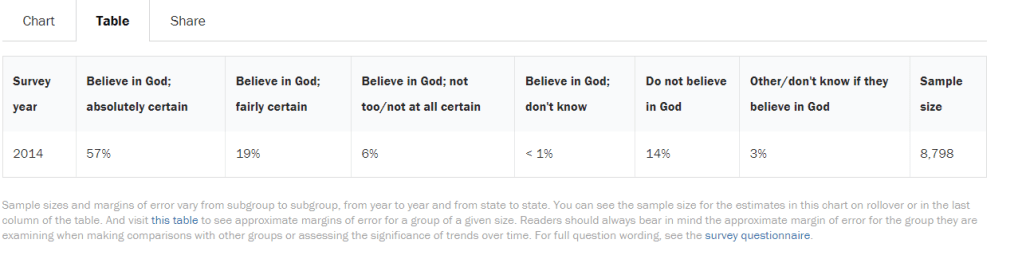
Taken from: https://www.pewresearch.org/religion/religious-landscape-study/educational-distribution/college#belief-in-god 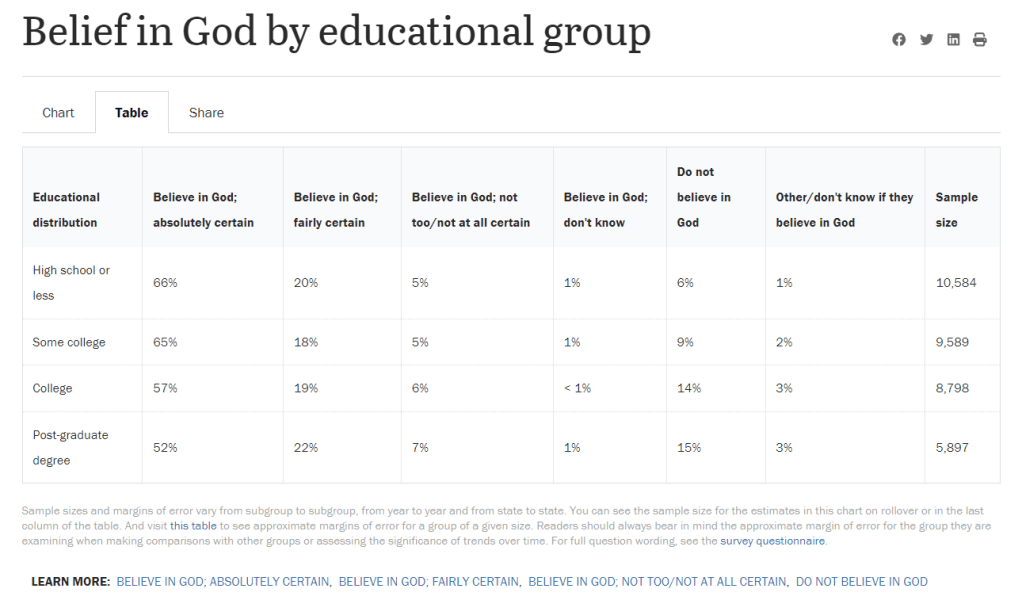
Taken from: https://www.pewresearch.org/religion/religious-landscape-study/compare/belief-in-god/by/educational-distribution#belief-in-god As seen, only 6% of High school or below graduates say they do not believe in god and 14% of the college graduates say they do not believe in god. Almost 2.5 times more. But that is not all. The addictiveness of the disorder known as religion is also more widespread among those who do not have college level education.
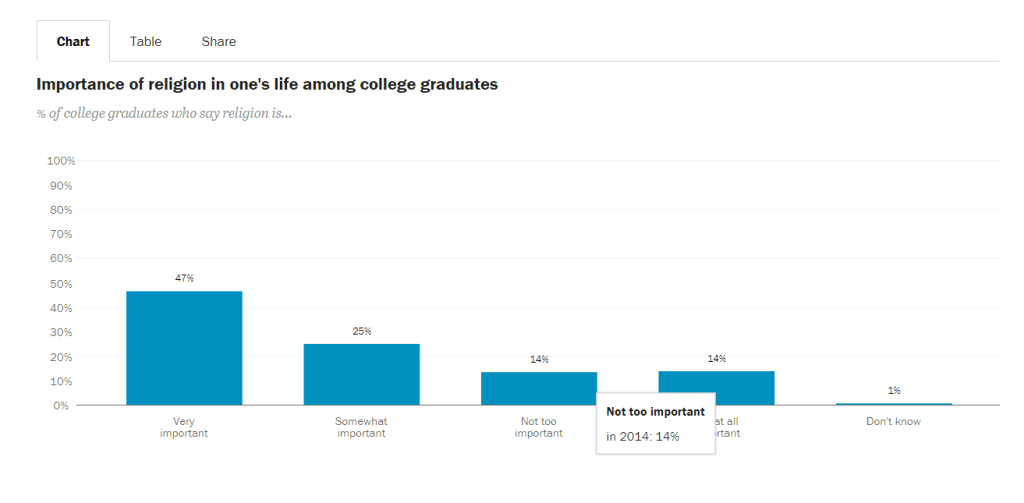
Taken from: https://www.pewresearch.org/religion/religious-landscape-study/educational-distribution/college#importance-of-religion-in-ones-life Pew Research’s study titled “In America, Does More Education Equal Less Religion?5“, we are told the following:
among U.S. adults overall, higher levels of education are linked with lower levels of religious commitment by some measures, such as belief in God, how often people pray and how important they say religion is to them.
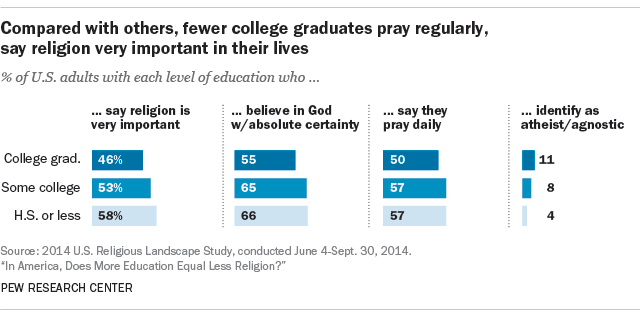
and this one is worth-sharing:
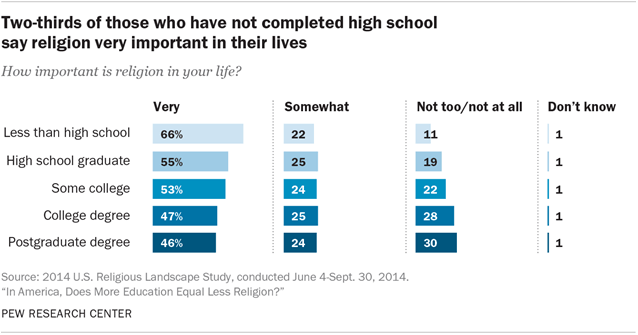
As we see, as the level of education climbs, the addictiveness and commonness of the disorder known as religion declines. While 66% of those who have no high school education says “religion is very important”, 47% of college graduates say that religion are very important to them. Sharp decline.
Knowledge Levels of Atheists and Theists
The estimate that there is a negative correlation between religion and intelligence is assessed since at least 1920. As a consequence of this, there were researches on “religion and intelligence” in many countries and as a result of these national-level researchs, the negative correlation between religion and intelligence is well-established6 7. Florian Dürlinger and Jakob Pietschnig lists 100 academic papers on religion and intelligence, held between 1928 and 20206. 86 of those studies have passed peer-review and got academically published whereas the remaining 14 was not. Those 100 papers had 105 cases in total and those 105 cases contained 112 982 participants. The peer-reviewed 86 studies had 103 216 persons in total. These 100 studies are listed here: https://journals.plos.org/plosone/article/figure?id=10.1371/journal.pone.0262699.t001 And here are the quick observations:
- 78 of the 86 peer-reviewed studies arrived at negative correlation between religion and intelligence, 8 of them arrived at positive correlation. In total, 89 of those 100 studies concluded negative correlation while 9 of them concluded positive correlation.
- The average of the 78 peer-reviewed studies that concluded negative correlation is -0,18 where as the average of 8 peer-reviewed studies that concluded positive correlation is +0,09. The highest negative correlation is -0,60 and the highest positive correlation is +0,24. The lowest ones are 0,01 for each side.
According to the work7 of Richard Lynn, John Harvey and Helmuth Nyborg:
- P. Bell’s 2002 article titled “Would You Believe It?” lists 43 academic studies on religion and intelligence, and 39 of those 43 works concluded negative correation.
- A survey held from 1538 participants in Netherlands had agnostics scoring 4 IQ higher than believers.
- A research held among 14 277 American youths had “not religious at alls” scoring 4 IQ points higher than “slightly religious” and “and very religious” ones. 103,09 IQ, 99.28 IQ and 98.28 IQ respectively.
- In a research held in 6825 American adolescents (aged 12-17), atheists scored 6 g-IQ points higher.
- There is a 0,60 positive correlation between lack of the god delusion and intelligence, spotted from data collected from 137 nations.
The god Delusion Percentage of Professional Philosophers
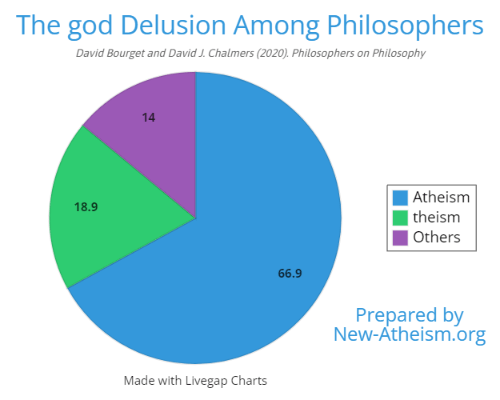
We have looked at IQ and Education levels (I skipped scientists since they are well known), now let us proceed into how many percentage of philosophers has fallen into the god delusion. There are 2 studies that include it as well. The first one was by Bourget and Chalmers, who has sent survey to 1972 members from (as they say) 99 leading philosophy departments of philosophy, 89 of which was PHD-granting department. Only 931 of them completed the survey and Here is the result on the god delusion issue:
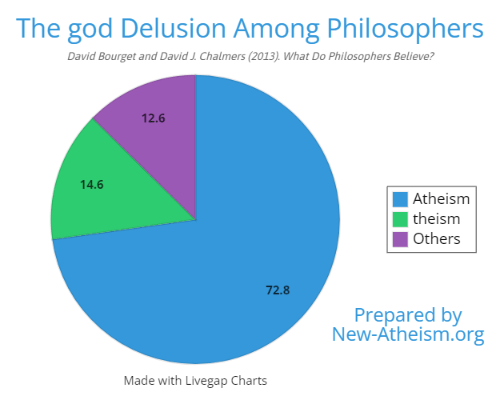
Same authors held similar survey with a bigger pool, in 2020. This time, the professional philosophers who have successfully recuperated from theism turned out to be 66.9%. As mentioned, the pool was bigger this time. Those who were sent the survey was 1800 professionals, from a wider scope. If you want, you can just reach at the paper and read for more. There are good insights like what percentage of philosophers fall for certain idiotismas presented as “argument for the existence of god”.
Final Words
Here, we do not propose any kind of conclusion like “this group is intrinsically more intelligent” or vice versa. We just list and exhibit some of the works done on this topic. The conclusions are on you, up to you – whatever you derive from it.
REFERENCES:
- https://www.pewresearch.org/religion/2010/09/28/u-s-religious-knowledge-survey/
- https://www.pewresearch.org/religion/2021/01/14/measuring-religion-in-pew-research-centers-american-trends-panel/
- https://www.census.gov/newsroom/press-releases/2022/educational-attainment.html#:~:text=The%20percentage%20of%20the%20population,from%2030.4%25%20to%2037.9%25.
- https://www.pewresearch.org/religion/religious-landscape-study/educational-distribution/college/
- https://www.pewresearch.org/religion/2017/04/26/in-america-does-more-education-equal-less-religion/
- Dürlinger F, Pietschnig J (2022) Meta-analyzing intelligence and religiosity associations: Evidence from the multiverse. PLoS ONE 17(2): e0262699. https://doi.org/10.1371/journal.pone.0262699 https://journals.plos.org/plosone/article?id=10.1371/journal.pone.0262699
- Lynn, Richard; John Harvey; Helmuth Nyborg (2009). “Average intelligence predicts atheism rates across 137 nations”. Intelligence. 37: 11–15. doi:10.1016/j.intell.2008.03.004.
-
The Reason Even Many [Seemingly-]Atheists Bash New Atheism Is …

One of the steps that are performed to discredit New Atheism has been to point out [seemingly-]atheist so-called critiques of New Atheism. Michael Ruse’s supposed critique has been an exemplary miniature of this strategy.
*Conventionally*, thilosophers (note: thilosophy is a theology in the ‘clothing’ of philosophy) has successfully made the god delusion seem in the scope of mere philosophy for decades and one of the features of the New Atheist Paradigm has been to spread demanding empirical/scientific evidence/demonstration of god. And since this step’s constitution of a lethal blow to the Ponzi Scheme of thilosophers is foreseen by the thilosophers, all thilosophers united in a chorus bash New Atheism. How is this a blow?
If you can keep the god delusion a topic of philosophy only and dictate that this disputation has to be interested in by all, you can earn money by selling thilosophy. For example, only by that way a theist thilosopher markets his/her book titled “The Ontological Manipulation in favour of the god delusion” and only by that way a seemingly-atheist thilosopher can market his book titled “A Rebuttal to the Ontological Manipulation in favour of the god delusion“. This cycle goes on: theist responds (and sells books), then in turn the other side responds (and sells books). It is done by thilosophers In all fields of philosophy – morality, consciousness, mathematics, cosmology etc. Both sides earn money by maintaining this illusory dictation named god: Philosophically, the idea of god is not even decent, the god disputation is sound financially: the god disputation generates money for thilosophers and that is why thilosophers force this disputation to remain alive. Thanks to this forced god discussion, philosophers can earn money by selling their mere thoughts.

And that is where the lethal blow of New Atheism (at the same time, of Positivism) comes: If it becomes known that there is nothing wrong with asking empirical evidence for god, the disputation will be settled down (at least temporarily): you can demonstrate your assertion, people accept it – you fail to demonstrate your assertion, people reject it. Full Stop. Then, people will no longer feel they have to buy, read and research fantasies of thilosophers – people won’t be buying abstract mere fantasies of thilosophers and all those thilosophers will go bankrupt. That is why all thilosophers, let they be a theist or seemingly-atheist, bash New Atheism.
As New Atheism spreads, people won’t be fool enough to be fooled into being persuaded that they need to spend time, money and energy for useless questions like “does god exist? is the argument from morality sound? what is the nature of nature? what is the nature of time?” – the questions so-called philosophy has failed to settle down in 2500 years.
If you want to read more about baseless, urban-legend repetitions of neotheists on New Atheism being sciencism, read the following: https://new-atheism.org/2022/12/23/new-theist-hoaxes-1-new-atheists-are-sciencist/
-
What the War in Yemen reveals about [majority of] muslims and pro-palestinians

On the 7th of October, the terrorist organization Hamas launched an attack on Israil: Hamas terrorists murdered hundreds of civilians, captured some. I am not here to re-narrate the events. I am not going to how muslims around the world celebrated Hamas’ attack at first, thinking they will win this time, but seeing Israel started to have an upper hand, muslims and pro-palestinians all over-the-world started to cry: “Israel is killing civilians, innocents” we were told.
Also, I am not here to argue one side is wrong or the one side is right. Here, we shall suppose Israel is 100% wrong on this one and the terrorists were 100% victim. Let us suppose Israel is killing innocents there. I am here to draw your attention into another thing.
You know, pro-palestinian protest marches are being held around the world: they are mainly muslims but there are jew, christian, atheist etc pro-Palestinians as well.

Pro-Hamas Protests in Australia. Courtesy of: The Guardian. 
Apro-Hamas rally in Jordan. [Alaa Al Sukhni/Reuters]. Taken from: Al Jazeera. 
Pro-Hamas Protests in London, on the 14th of October. Taken from: time.com No need for further examples. From Japan to Hawaii, pro-Hamas rallies are being held everyday. While these rallies all correspond to being pro-Hamas, I guess most of the time the actual intention of those people is pro-Palestine. Also, my aim in this writing is not consisted of this clash only – thus, I am using the term “pro-Palestine”.
As I said before, we are here supposing Israel is murdering innocents.
Now, let us think about the war in Yemen: Saudi-let coalition against supported-by-Iran opposition. The war has created one of the worst humanitarian crises in the world. According to the UN, more than 21 million people need aid, including 11 million children, and more than 4.5 million are displaced. Severe acute malnutrition is threatening the lives of almost 400,000 children under the age of five. Yemen’s health system has collapsed, while the world’s largest cholera outbreak has killed thousands. The war has also damaged Yemen’s infrastructure, economy, and cultural heritage. Hundreds of infants and children were forced to starve to death. According to Unicef, “The humanitarian situation in the country is poised to get even worse between June and December 2022, with the number of people who likely will be unable to meet their minimum food needs in Yemen possibly reaching a record 19 million people in that period, the Food and Agriculture Organization of the United Nations (FAO), the UN World Food Programme (WFP) and UNICEF alerted, following today’s release of a new Integrated Phase Classification (IPC) analysis on Yemen.”

A malnourished Yemeni child lies on a hospital bed in the Hajjah province as conflict pushes country to brink of famine CREDIT: ESSA AHMED/AFP. Taken from: telegraph.co.uk Have you ever seen those pro-palestinians protesting Saudi Arabia and Iran? If, as we supposed here, Israel was killing innocents, are Saudi Arabia and Iran not killing innocents in Yemen?
Israel was widely alleged to have destroyed the Al-Ahly hospital and pro-Palestinians went mad about it, their voice got even louder as they felt they are politically right in an undisputable way: How come Israel can kill innocents? How come Israel can attack a hospital? Let us suppose it was attacked by Israel. If this was really the reason those muslims and pro-palestinians are protesting, let us consider how many hospitals has Saudi Arabia attacked in Yemen:
- Back in 2019, Associated Press reports that Saudi Arabia attacked (and destroyed) more than 130 hospitals in Yemen.
- Back in 2021, Losservatorio reports that Saudi-led coalition has destroyed more than 500 medical facilities.
- According to Human Rights Watch’s 2020 report on the Yemeni war:
- Saudi Arabia and Iran has killed 175 000 civilians.
- 20 million people are experiencing food insecurity.
- 10 million of them are on the risk of famine.
- Saudi-led coalition has executed more than 20 100 airstrikes, 12 times a day on average.
- Both sides have deployed child soldiers: under 18 and even under 15.
No need to go further: as much as evil Israel is alleged to be, so has to be argued Saudi Arabia and Iran for their actions in Yemen.
Yet, I am yet to even hear a single rally in which muslims gathered and condemned Saudi Arabia and Iran. When it is muslims that are doing the exact same things Israel is alleged to have done, the entire world ignores it, it goes unnoticed.
Now, coming back to the title, the question: What War in Yemen reveals about [majority of] muslims and pro-palestinians is that they are Jewophobs. They are just manifesting their Jewophobia by disguising it as “stance for innocents” etc.
We New Atheists do not fall for this ruse but so called intellectuals will stigmatize us as “islamophob” though…
-
PZ Myers:

Substance over sweetness — another New Atheist critique gone askew
Another of those common, erroneous strategies used to criticize those danged Gnu Atheists is to first invent a definition for New Atheism that the New Atheists themselves would find foreign, and then to jump all over it for a prolonged period of time until they’ve convinced themselves they’ve finally defeated their nemesis. It’s the cardboard cutout tactic — it turns out that cardboard versions of us put up much less of a fight than the real thing.
I’m afraid Stephen Asma has committed the same error. He has written a long, meandering essay that accuses the New Atheists of having a narrow worldview because, he thinks, all we know about is Christianity and Islam. What about Buddhism, he asks, or animism? And then he does tell us some interesting things about Buddhism and animism, but they’re all entirely irrelevant, because he has completely missed the point.
Asma errs by thinking he has encapsulated the Gnu Atheists as people who reject Christianity and Islam because they do a poor job of explaining nature and guiding morality, and that therefore he can make a case for the inadequacy of that atheism by showing that there are other religions that do not consider explaining and moralizing to be their primary duties: Buddhism, for instance, is about finding psychological contentment, while animism is a reflection of mankind’s helplessness and lack of control. We could argue about those characterizations — Asma admits that Buddhism as practiced has supernatural and ritual elements, too, for instance — but let’s not, for now. I want to argue with his narrow and erroneous worldview of what a Gnu Atheist is.
Gnu atheism is not simply about what isn’t. Our views do find expression in specific criticisms of specific faiths, but those are just the epiphenomena of a deeper set of positive values that Asma completely misses. Certainly I will make moral arguments against religious pathologies — Catholic priests raping children is bad — and I will judge beliefs by the foolishness of their explanations — creationist dogma is utterly absurd. But to say that is the guiding philosophy of atheism is to mistake the actions for the cause. I have one simple question you can ask of any religion, whether it’s animism or Catholicism, that will allow you to determine the Gnu Atheist position on it.
Is it true?
I’ve told people this many times. The Gnu Atheism is a positive movement that emphasizes the truth of a claim as paramount; it is our number one value. This is why you’re finding so many scientists who consider themselves in this movement — it’s because that’s how we’re trained to think about hypotheses. Also, because there are many scientists and philosophers behind this idea, I should also emphasize that we’re also well aware that “truth” is not some magic absolute, but something we can only approach by trial and error, and that truth is something you have to work towards, not simply accept dogmatically as given by some unquestionable source…which is another difference between us and religion. A scientific truth is more complex than a colloquial truth, it’s requirements being that it is free of contradiction with logic and reality and supported by reason and evidence.
Asma’s big mistake is assuming that our central question is, “Is it good for us?”, which leads him into all these pointless anecdotes about how praying makes him feel better, and how animism helps impoverished people cope with their circumstances. I don’t care if religion makes someone feel better. Stacking illusions over a grim reality does not turn it sweet. I have my anecdotes, too; I remember the tragedy of my little sister’s death a few years ago, and how I sat through a funeral in which the preacher declared with absolute certainty that she was in heaven, and all I felt was anger. Lies do not make me feel better. There is no consolation in fantasy. You can sugar-coat the truth as much as you want, you can make up extravagant stories of my sister living in constant joy and rapture, frolicking with lambs and puppy dogs in fields of sweet clover while angels on gentle zephyrs sing to her, and it would not give me one instant of comfort. I do not lie to myself, and other people lying to me under the delusion that it will make me happier I find unconscionable.
Seriously, it’s worse than that. I despise people who try to swaddle truth with lies in the name of consolation. It kills ambition, the striving to make the world better in the future, and it can allow evil to lurk unchecked. Those child-raping priests persisted because people lied to themselves, telling themselves that no man of god could do something so heinous…and even when finally exposed and removed, they continued to live in denial, reassuring each other that the institution that protected those vipers really was a force for good, overall.
So Asma is barking up the wrong tree when he thinks this is the relevant question:
So how do we discriminate between dangerous and benign religions? That is the more fruitful question, because it invites the other world religions into the discussion. Both the developed and the developing worlds can profitably examine their unique belief systems in light of larger human values. Like Harris et al., I agree that we should employ the usual criteria of experience to make the necessary discriminations. Religious ideas that encourage dehumanization, violence, and factionalism should be reformed or diminished, while those that humanize, console, and inspire should be fostered.
He really doesn’t get it. He could show me a religion that is nothing but sweetness and light, happiness and good thoughts and equality for all, and it wouldn’t matter: the one question I would ask is, “Is it true?” It wouldn’t matter if he could show empirically that adopting this hypothetical faith leads to world peace, the voluntary abolishment of crime, the disappearance of dental caries, and that every child on the planet would get their very own pony — I’d still battle it with every fierce and angry word I could speak and type if it wasn’t also shown to be a true and accurate description of the world. Some of us, at least, will refuse to drink the Kool-Aid, no matter how much sugar they put in it.
It is also the case that every religion describes itself as benign. Ask the true believers in even the most hateful, violent faiths, and they will all say they are workin for the betterment of their people. Women like wearing burkas, they will say, and they’re happier when liberated from civic responsibilities, like voting, or doing a man’s job.
Asma does go on at length about the virtues of animism in the third world, where it is a coping mechanism to live with difficult lives and high-risk environments, but I think he’s also wearing those rosy glasses that transmit lies to his nervous system. It makes them happier, he claims, but African animists still die of starvation, thirst, and disease, and African animists are using their faiths to accuse children of witchcraft to justify setting them on fire, or butchering unfortunate albinos to use their body parts in magical rituals. So even his examples of a benign religion don’t hold up unless we close our eyes to much of what’s done in their name.
Asma concludes with a typical unsupported plea; atheism’s “proponents need to have a more nuanced and global understanding of religion.” No, we don’t. Show us that it’s true, first, and then we can talk about nuance, and implementation, and consequences. Telling us how it makes some people feel good doesn’t even begin to address our core objections.
-
Jester’s Privilege – Religions!

Jester’s privilege is the ability and right of a jester to talk and mock freely without being retaliated or sanctioned or punished. Latest developments from UNO demonstrated that New Atheism has been right: that religions enjoy Jester’s Privilege.
The UNO’s attempt to suppress the Freedom of Speech and Expression when it comes to religions demonstrated how right New Atheism has been since its manifestation.
Currently, there are news (1, 2, 3) of UNO trying to pass a global law that bans people from exercising their right to freedom of speech when it comes to religions. Unsurprisingly, it was supported more than it was opposed:
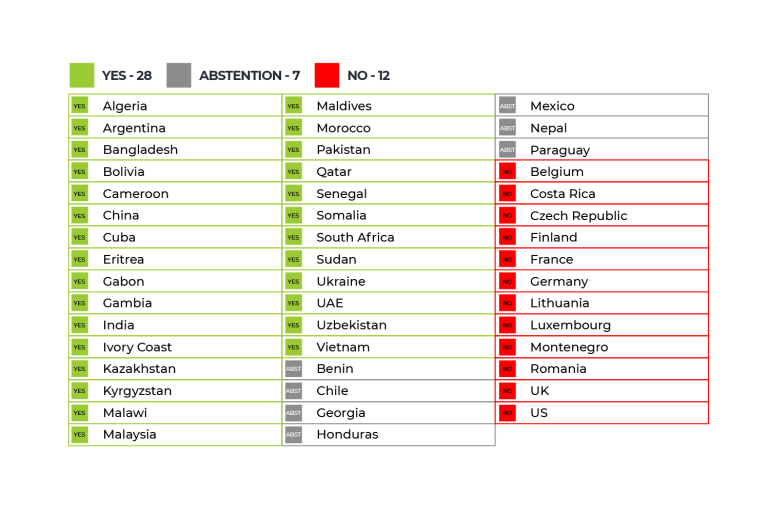
That is not all, some countries which are usually considered rational and democratic are also trying to suppress Freedom of Speech when it comes to religion: Denmark and Finland. All all these attempts do is to remind us prominent New Atheists telling this truth long ago. One of the main things the prominent figures of New Atheism has been yelling is the fact that religions have what we call the Jester’s Privilege. Richard Dawkins put it in this way in his book The God Delusion:
A widespread assumption, which nearly everybody in our
society accepts – the non-religious included – is that religious faith
is especially vulnerable to offence and should be protected by an
abnormally thick wall of respect, in a different class from the
respect that any human being should pay to any other.New Atheists have been vocal in attacking religions in an outspoken way. New Atheism’s prominent figures have expressed this call. And this, probably, is the demarcation between New Atheists and other “conventional” [so-called] atheists. Stenger described it in this way:
Here the New Atheists find themselves in conflict with many other atheists who prefer to accommodate religion and not challenge beliefs, even when those beliefs conflict with well-established science. However, the New Atheists say we should challenge the irrational thinking behind religious beliefs, including that of moderates, which can only help justify the more extreme activities, as well as motivate less extreme, but still dangerous, behavior.
Taken from: Victor Stenger – What is New About The New AtheismEarlier, the conversation that sparked the Enlightenment too featured these 2 topics. Indeed, the beginning of the conversation of The Four Horsemen was on this issue. Richard Dawkins started:
One of the things we’ve all met is the accusation that we are strident or arrogant or vitriolic or shrill. What do we think about that?
to which a part of Daniel Dennett’s reply was great:
I came to realize that it’s a no-win situation. It’s a mug’s game. The religions have contrived to make it impossible to disagree with them critically without being rude.
and the conversation went on:
DENNETT: You know, they sort of play the hurt-feelings card at every
opportunity, and you’re faced with the choice of, Well, am I going to
be rude? Or am I going to—
DAWKINS: Say nothing, yes.
DENNETT: —articulate this criticism? Or I mean am I going to
articulate it or am I just going to button my lip and—?but the main spot-on moment came from Sam Harris:
Well, that’s what it is to trespass a taboo. I think we’re
all encountering the fact that religion is held off the table of rational
criticism in some kind of formal way, even by, we’re discovering, our
fellow secularists and our fellow atheists. It leaves people to their
own superstitions. Even if it’s abject and causing harm, don’t look
too closely at itAs we see from the attepmts and the speeches of prominent New Atheists, Religions are granted Jester’s Privilege. And now, we should oppose those attempts. There is a rationale for this:
- To begin with, it is his/her book, so, s/he can burn it, tear it, use it instead of toilet roll or as a wood for fire.
- Religions are not private: they are ideologies that refer to societies, all individuals, all humankind. Thus, just like communism, you can mock it, you can scorn it, you can respect it.
- Even if all ideologies, not religions only, were granted the same privilege, we should still be free to mock religions in anyway as those religions attack and insult us.
I am not going to list all the insults religions throw at others who do not subscribe to their nonsense, you can find them easily by googling and taking a look at their context. Despite all these, even many atheists display that “we shall respect religions” attitude. “
Religions shall insult others as they wish, may religions discriminate, ostracize, may the religious be completely free and maintain the Jester’s Privilege: Religions should never be opposed!” You were brainwashed to be so, but now we tell: get rid of this brainwashing. Broke this Jester’s Privilege.All in all, all rational and sane people should oppose UNO’s attempt to maintain the Jester’s Privilege religions have and join us fighting and mocking religions.
New Atheism – Rational People of the World, Unite!
-
Dawkins’ razor
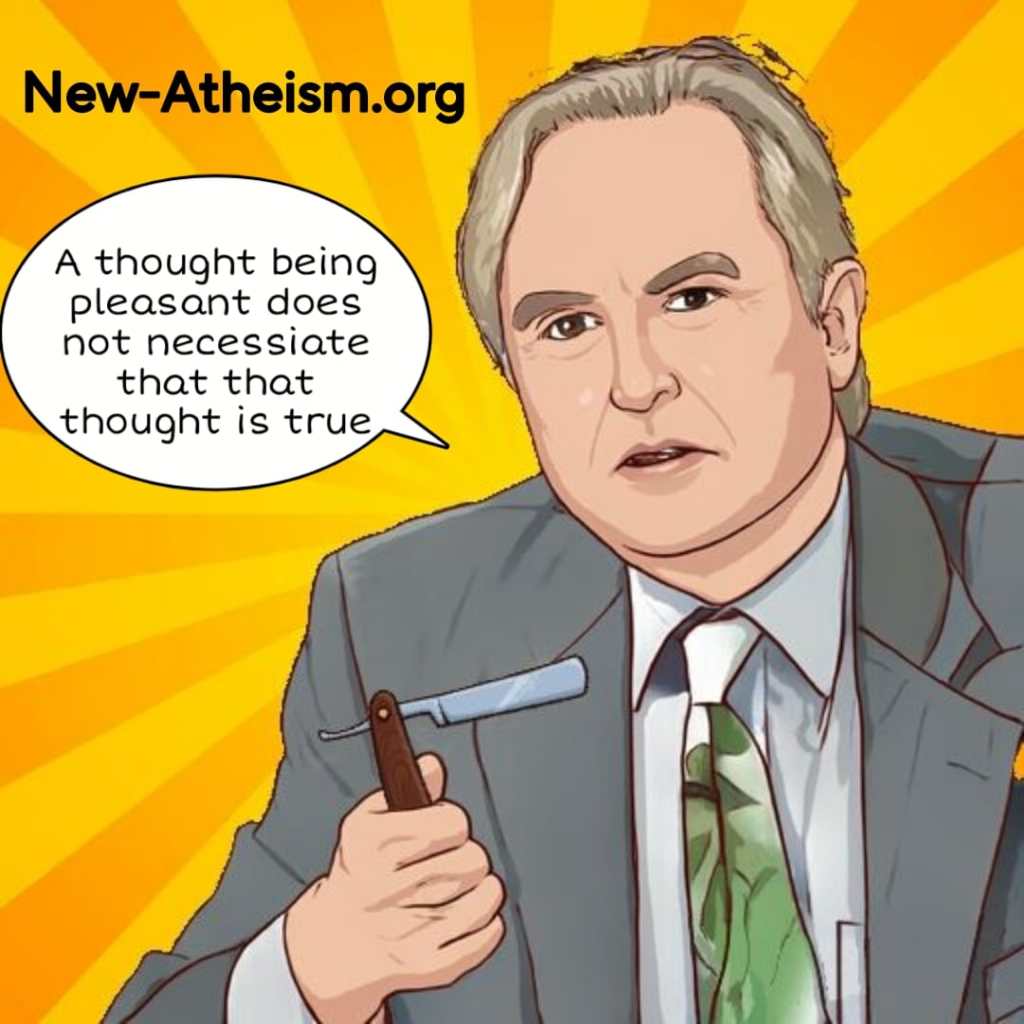
You can not argue for some truth about the universe by saying that it would be nice if it were true
said Dawkins, addressing William Lane Craig who was talking gibberish (as always), emphasizing something like (not quoting verbatimly) “if atheism is true, then we are doomed to death and that is where theism comes: we are promised eternal life“. And the above quote was where the disputation came down to and settled down.
What Dawkins said there was actually a philosophical razor. I paraphrase Dawkins’ Razor as follows:
Just because something sounds nice does not entail that it is true.
The Dawkins’ Razor clearly reveals what kind of baseless dictations religions are. “If god exists, then, there is eternal life. So, god exists.” Every promise that we hear from the frauds are very nice-sounding but unfortunately, just because they are nice did not necessitate that their promises to be true. That is what makes Dawkins’ Razor important and that is why theists should be educated on this one, just like William Lane Craig was educated by Richard Dawkins.
-
Neotheist myths: “Rocks are atheists?”

We rational people hold that atheism is lack of delusion in fairytale character myths known as gods. Neotheists are famous for disputing this truth and dispute it often as “atheism is a belief that there are no gods” (for example: Graham Oppy). They do it with, in my eyes, three purposes:
- That is how you sell your hobby (philosophy): if you can make it conventional that atheism is a belief that there are no gods, then you can keep on selling your arguments, elaborations and explanations about why there are no gods. At least, this way will increase your sells and rates.
- Assigning burden of proof into atheists: “just like me, you too have to prove your case. If mine is unproven, so is yours.”
- To take one down to quicksand with yourself: “I am unable to deal with the fact that my faith is irrational, but then, I am going to pull you down with myself.”
I can think of other reasons as well but I am not going to commentate on them. Attempts to shift the burden of proof into atheists, or at least make it shared, is probably the most common, and the most idiotic, cheap tactic of many theists and neo-theists.
As far as my observation goes, the most common way of this cheap tactic is the following:
if atheism is merely a lack of belief in God, then rocks, trees, and outhouses are all “atheists” because they too lack a belief in God. It doesn’t take any brains to “lack a belief” in something. A true atheist believes that there is no God.
taken from crossexamined.org, a Christian apologetics website.Any functional brain could easily decipher the blatant manipulation here.
- Innocence, for example, is lack of crime and/or guilt – have you ever seen a neotheist arguing “no, innocence can not be as such, otherwise, rocks, trees, houses are all innocent. So, we shall define innocence as those who oppose crime exists”? If anyone argued so, feel free to quote and cite him/her.
- Homeless, for example, means “without home“, have you ever seen a neotheist objecting to this definition by arguing “no, homelessness can not mean lack of home, otherwise, rocks, trees etc all are homeless. So, we shall re-define homeless as someone who believes homes do not exist”? If anyone has ever argued as such, please, quote and cite him.
But this cheap tactic’s folly is beyond it. There are many ongoing wars (unfortunately) and we always try to evacuate the civilians from clash zones. What does civilian mean at all? Not belonging to an army (or to armed forces). Babies are considered civilians – have you ever seen a neotheist arguing “no no no. A baby can not be considered a civilian. We shall re-define civilianness as someone who opposes belonging to armed forces. Otherwise, rocks and trees are also civilians we have to transfer somewhere else as they do not belong to an army or any armed forces.” If we were to follow that neotheistic rationale, we would have to argue that babies can not be considered civilian and we would have to oppose the transfer of babies from warzones. Fortuneately though, this neotheistic way of arguing is not taken seriously by any sane person.
Now, you have seen that this neotheistic myth too is absurd and does not hold, just like all of them.
New Atheism – The Actual Salvation.
-
neotheist hoaxes 3 | Bible Canonization in Nicene Creed is a Myth of Muslims, not [New] Atheists
INTRODUCTION
Academic works by even Muslim theology departments explicitly and unequivocally admit that it was muslims who spreaded the myth on gospels (or the entire bible) being canonized in the Nicean Creed, as we will see in the next sections but a neotheist, who asserts to be an atheist himself, spreads this myth as if it belongs to [New] Atheists. In this article, we will see how clueless, ignorant and charlatan fraud neotheists are in general and Tim O’Neill in particular (though this is the only neotheist entity I know that spreaded this hoax, his audience is a good example of how ignorant neotheists are and how you can throw any lies at New Atheists without even being asked for a back up). In this article, you will be presented the following assessments from the contemporary scholarship and academy:
- A book being canonized in Nicene Creed dates back to 4th century Christian theologian, historian and Saint, Saine Jerome.
- The origin of the assertion of Nicene Creed canonizing books is the Eastern Christian church.
- The assertion that Nicene Creed chose canonical books is popularized by Muslims.
- Neotheist Tim O’Neill is a pseudo-atheist that slanders the New Atheist movement which seeks to cure people from religions and theism.
neotheist Hoax: “New Atheists Assert that Bible was Canonized in 4th Century”
A neotheist posted ‘an article’ titled “The Great Myths 4: Constantine, Nicea and the Bible”. According to this neotheist’s writing, a facebook group named “PHILOSOPHICAL ATHEISM” posted a meme in which it is stated that Constantine and his bishops voted for some books which currently constitutes the bible. Here is the meme this neotheist attributes to New Atheism:
Then, this neotheist labels this PHILOSOPHICAL Atheism group’s post as “New Atheist bad history”. The first make-fool-of is the idiosyncratic strawman of this neotheist: a factually wrong assertion of someone else is taken, patched into New Atheists and then claimed New Atheists are wrong.
The second make-fool-of is that when something wrong is detected, that wrong is attributed to New Atheists and then refuted: the idea is clear, to play to the crowds consisted of the religious. If this neotheist attributed it to Muslims (as it really is), or, if those so many Muslims are rebutted for spreading this myth, then he will lose his muslim audience, why jeopardize it? Instead, just attack those already marginalized New Atheists, please your audience and sell more. Why not? After all, neotheism works.
The third make-fool-of is that this neotheist implies those atheists advised to “look it up” without they themselves looking it up:
The irony of this meme urging readers “Don’t just believe me. Go look it up.” is particularly amusing. But okay, let’s “look it up”.
Ok, let us look it up and see who the actual ignorant clueless bad historian is.
Then, the next blatantly false part is that this neotheist first states that the origin of this myth can be traced to Voltaire. But later on this neotheist gives the actual possible origin, an Eastern Orthodox document named Vetus Synodikon. Presenting Voltaire as the origin of this source is a strategic move, Voltaire is known to have fought cruelties named religions, thus, he was a New Atheist: Instead of naming the actual origin this myth, which was an Eastern Christian document, just smirch New Atheists: if the actual sinner, a theist, was acknowledged to have created this myth, this neotheist would not be selling to other theists, he would not be pleasing his audience but if a New Atheist is shown as guilty, then his audience would buy it, would applaud him.
Let us now look it up who spreaded this myth.
CONTEMPORARY SCHOLARSHIP: MUSLIMS SPREADED THE MYTH ON BIBLE BOOKS BEING SELECTED IN NICENE CREED
Contrary to neotheists, there are some non-neotheist theists who explicitly ADMITS that this myth is not only spreaded by Muslims but actually was asserted by Christians.The very first example I am going to show is the Islamic Encyclopedia by the Directorate of Religious Affairs of Turkey, they have an article on the Nicene Creed [1] and it has a section titled Nicene Creed in Islamic Sources. The most important part of this article is that it explicitly states the following (personal translation from Turkish below):
İslâm kaynaklarında Ahd-i Cedîd’i oluşturan kitapların, özellikle İnciller’in sayısının İznik Konsili’nde belirlendiği şeklinde ifadeler bulunmasına rağmen gerek ilk dönem konsil kararlarının kaydedildiği kilise tarihi kitaplarında gerekse diğer hıristiyan kaynaklarında böyle bir bilgiye rastlanamamıştır.
In English: Despite the statements about books that constitute the New Testament (Ahd-Cedid), especially the number of gospels have been decided in Nicene Creed occurs in Islamic sources, such information is found in neither the books on Church books containing the earliest council decisions nor the other christian sources.
Here, The Islamic Encyclopedia of the Directorate of Religious Affairs of Turkey explicitly admits that the assertion which this neotheist Tim O’Neill presents as New Atheist bad history is popularized by Islamic sources. Then, the same article presents Rahmatullah Al Hindi as the spark of this myth’s spread, states that Al Hindi wrote that Christians religious scholars gathered in Nicea to discuss if the deuterocanonical books are to be reckoned among sacred texts and explicitly states that “despite such information not being present on christian sources”. Then, the encyclopedia shows Abdul Ahad Davud as the one who spreaded the idea that 27 books of the New Testament was chosen in Nicene Creed. But that is not all, according to the same article, Abdul Ahad Davud went so far as to assert that Arius, who defended unitarianizm, was pressured; 700 (seven hundred) scholars were kicked out in accordance with the command of Constantine and the remaining 318 scholars were forced to sign the Nicene Creed which states that the father and the son was from the same substance.
Then, in the journal of the Faculty of Theology of the Marmara University, we see another non-fraud academic that acknowledges that this myth is spread by Muslims. In his article titled I. Nicene Creed (325) and Its Place in Islamic Sources [2], Associate Professor Dr. Ismail Taşpınar states that reports about gospels being selected in I. Niece Creed (325) is seen especially in the recent Islamic sources (page 39, 2nd paragraph, 1st sentence). Like the Islamic Encyclopedia of the Directorate of the Religious Affairs, Taşpınar too shows Rahmatullah Al Hindi as the one that sparked this myth and adds that neither the medieval Islamic sources nor the Christian sources featured such account (the following sentence of the just mentioned reference). But Dr. Taşpınar narrates that Al Hindi backs up his claim relying on the prologue by Jerome on the book of Judith which states that “found by the Nicene Council to have been counted among the number of the Sacred Scriptures”. As we can see, we have a 4th century Christian Saint who talks of at least one book being chosen as canonical in Nicene Creed.
Then, we have an Islamic Research Journal admitting that this myth is popularized by Muslims and Abdul Ahad Davud spreaded this myth. In his article titled “A Controversial Religious Council in Christian and Islamic Sources: Nicene Creed” in the Islamic Research Journal[3], Dr. Mustafa Sinanoğlu, who is an author at the Islamic Encyclopedia of the Directorate of the Religious Affairs of Turkey, narrates that Abdul Ahad Davoud wrote that 27 books of the New Testament have been selected from a tremendous numbers of books that would not fıt into a single library (page 14, 3rd paragraph). Also, Dr. Sinanoğlu accuses both Al Hindi and Abdul Ahad Davoud of not providing source for their claims on New Testament books being selected at this Creed (page 16, 2nd paragraph) and ends up stating that if it is not an assertion by them, then, it must be relying on another narratives.
Finally, neotheist Tim O’Neill himself talks about how Christian Theologian got the Vetus Synodikon published but he presents it as “medieval Byzantine work” only whereas it might well be an Eastern Orthodox point of view.
CONTEMPORARY MUSLIMS ASSERTING THAT THE BIBLE BOOKS WERE CHOSEN IN NICENE CREED
Just like in the past, there are still lots of popular Muslims that spread this myth. Yasir Qadhi is an example,here is a facebook writing[4] about it. Here is what he states:
Eventually, based on this Nicene Creed, four Gospels that now form the essence of the New Testament were selected to be part of the Bible, and all other gospels and manuscripts that didn’t support the Nicene creed were subsequently destroyed and their knowledge forever lost in history.
And here is his youtube narration about this topic: https://www.youtube.com/watch?v=Tu707oWxGqM He has 556K subscribers, his video has been watched 110K times and if you read the comments, you will see muslims praising that Shayk.
I can cite many examples but no need to prolong the text. Let us move into conclusions.
CONCLUSIONS AND MORE
As we have seen, here is how clueless ignorant this neotheist Tim O’Neill is summarized:
- Patching a Christian-Muslim myth into Atheists.
- Patching a PHILOSOPHICAL Atheists’ myth into New Atheists.
- Being unaware of history.
- Being unaware of religious discussions.
- Being unaware of, ignorant of and clueless about the Book of Judith, Saint Jerome and Vetus Synodikon
But the main problem is that, it is almost impossible to be unaware of the fact that Muslims are still spreading this myth yet this neotheist is silent at all those Muslims yelling this myth and when an atheist, probably non-famous, non-influential, yells this myth – this neotheist immediately exclaims at NEW Atheists. It is not hard to understand the purposes of his moves: If he shouts at theists or PHILOSOPHICAL atheists, he will no longer be touted as “intellectual, unbiased, knowledgeable” person. If you want to be seen as an intellectual person without being so, just exclaim at New Atheists, then you will be seen as such.
As is clear from the previous 2 hoaxes by neotheists (1 and 2), neotheists deploy a propaganda strategy attributed to Nazis: “Just repeat your life thousand time and your lie will be seen as a fact.”
Neotheists attained an intellectual immunity in a way that they can throw any blatantly false slanders at New Atheists and can get away with it without being disputed, questioned, asked for a reference or any kind of scrutiny or back up. A neotheist website historyforatheists.com is the perfect illustration of neotheism.
Anyone who opposes New Atheism in anyway is a fraud, a charlatan, a liar, deceptive gold-digger that is seeking ways to sell more easily. Never trust any person who exclaims New Atheism because New Atheism is a movement that fights cruelties, a movement that stand for reason, science, thought, education, art and philosophy. If any of them prevails, cruelties legitimized as religions will be shaken; philosophy exploitation forced upon people due to theism will collapse: that is why even all those ostensibly atheist philosophers oppose New Atheism.
Outspoken Atheism – Thinking People of the World, Unite.
REFERENCES:
Reference informations all are given with-in the text, here, I am going to leave the links only through which you can access those citations
[1] https://islamansiklopedisi.org.tr/iznik-konsili
[2] https://dergipark.org.tr/tr/download/article-file/162656
[3] http://isad.isam.org.tr/vdata/sayi06/isad006_sinanoglu.pdf
-
Subscribe
Subscribed
Already have a WordPress.com account? Log in now.
 New Atheism