
Especially on internet, it is very common to see scenes in which both atheists and theists associate their own side with eruditeness and the other side with ignorance. In this writing, we will list the academically assessed datas about these topics: the god delusion rates by: education level, knowledge of adherents, IQ and expert philosophers. The writing will be consisted of the following:
- The god Delusion By Education Levels
- Religious and Philosophical Knowledge of Atheists and Theists
- IQ levels, Religiousity, Atheists and Theists
- The god Delusion Percentage of Philosophers
- Closing
The god Delusion By Education Levels
In this section, I am going to use the US data as they are the most easily found and the most accurately known. 2010 Report of Pew Research1 cited a 2007 survey, saying “atheists and agnostics combined account for about 4% of the U.S. population.” 2021 Report of Pew Research2 states that 4% are atheists.
According the US Census Bureau3, %30.4 of Americans aged 25 or over had bachelor’s degree in 2011 and in 2021, %37.9 of them had bachelor’s degree.
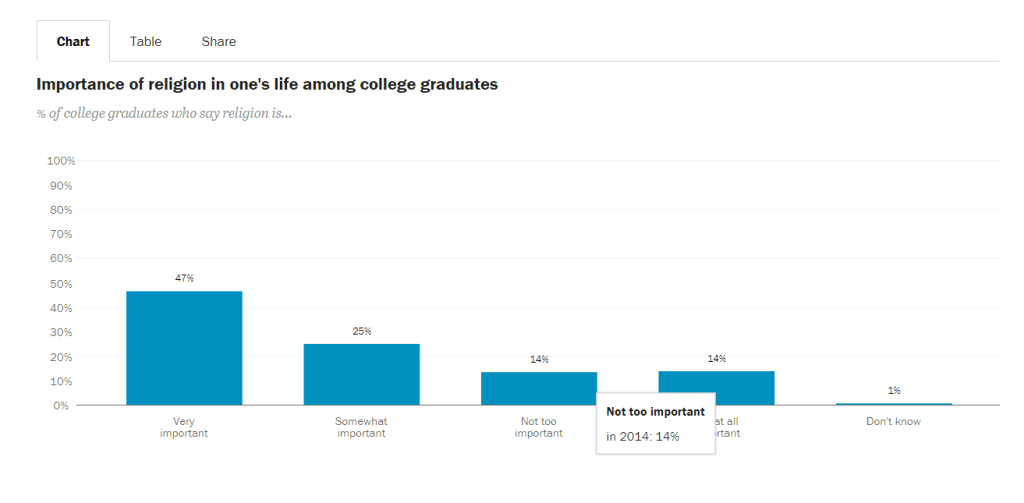
Pew Research’s Religious Landscape Study4 reports that %14 percent of the US College Graduates state that they do not bear the god delusion, meaning they are atheists and 25% of the college graduates are exempt from the psychopathic disorder known as religions.
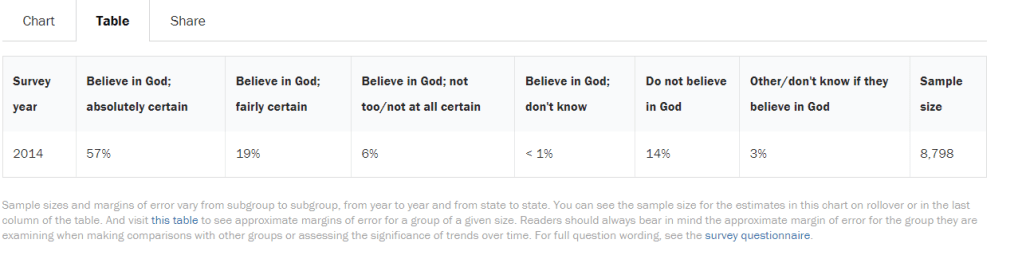
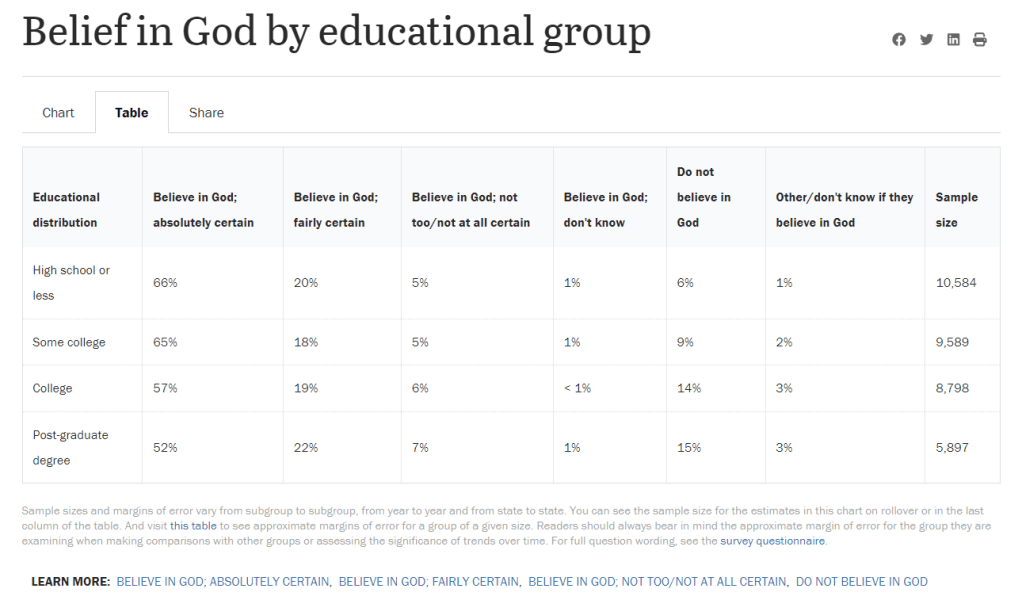
As seen, only 6% of High school or below graduates say they do not believe in god and 14% of the college graduates say they do not believe in god. Almost 2.5 times more. But that is not all. The addictiveness of the disorder known as religion is also more widespread among those who do not have college level education.
Pew Research’s study titled “In America, Does More Education Equal Less Religion?5“, we are told the following:
among U.S. adults overall, higher levels of education are linked with lower levels of religious commitment by some measures, such as belief in God, how often people pray and how important they say religion is to them.
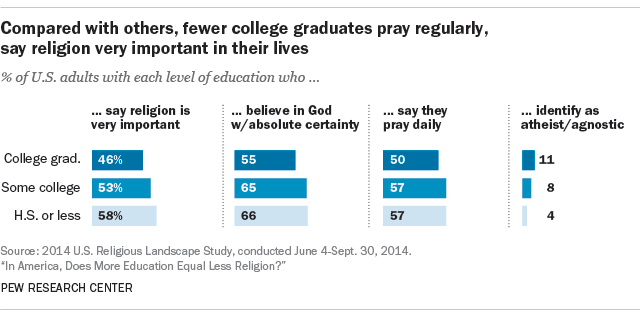
and this one is worth-sharing:
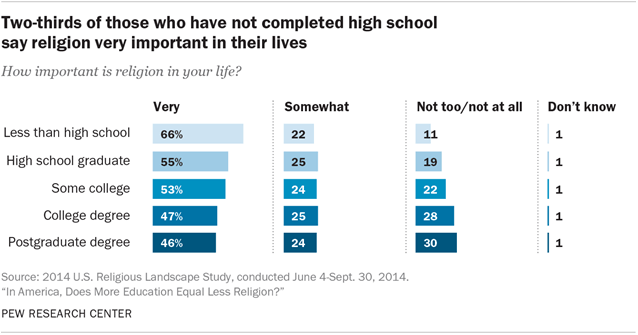
As we see, as the level of education climbs, the addictiveness and commonness of the disorder known as religion declines. While 66% of those who have no high school education says “religion is very important”, 47% of college graduates say that religion are very important to them. Sharp decline.
Knowledge Levels of Atheists and Theists
The estimate that there is a negative correlation between religion and intelligence is assessed since at least 1920. As a consequence of this, there were researches on “religion and intelligence” in many countries and as a result of these national-level researchs, the negative correlation between religion and intelligence is well-established6 7. Florian Dürlinger and Jakob Pietschnig lists 100 academic papers on religion and intelligence, held between 1928 and 20206. 86 of those studies have passed peer-review and got academically published whereas the remaining 14 was not. Those 100 papers had 105 cases in total and those 105 cases contained 112 982 participants. The peer-reviewed 86 studies had 103 216 persons in total. These 100 studies are listed here: https://journals.plos.org/plosone/article/figure?id=10.1371/journal.pone.0262699.t001 And here are the quick observations:
- 78 of the 86 peer-reviewed studies arrived at negative correlation between religion and intelligence, 8 of them arrived at positive correlation. In total, 89 of those 100 studies concluded negative correlation while 9 of them concluded positive correlation.
- The average of the 78 peer-reviewed studies that concluded negative correlation is -0,18 where as the average of 8 peer-reviewed studies that concluded positive correlation is +0,09. The highest negative correlation is -0,60 and the highest positive correlation is +0,24. The lowest ones are 0,01 for each side.
According to the work7 of Richard Lynn, John Harvey and Helmuth Nyborg:
- P. Bell’s 2002 article titled “Would You Believe It?” lists 43 academic studies on religion and intelligence, and 39 of those 43 works concluded negative correation.
- A survey held from 1538 participants in Netherlands had agnostics scoring 4 IQ higher than believers.
- A research held among 14 277 American youths had “not religious at alls” scoring 4 IQ points higher than “slightly religious” and “and very religious” ones. 103,09 IQ, 99.28 IQ and 98.28 IQ respectively.
- In a research held in 6825 American adolescents (aged 12-17), atheists scored 6 g-IQ points higher.
- There is a 0,60 positive correlation between lack of the god delusion and intelligence, spotted from data collected from 137 nations.
The god Delusion Percentage of Professional Philosophers
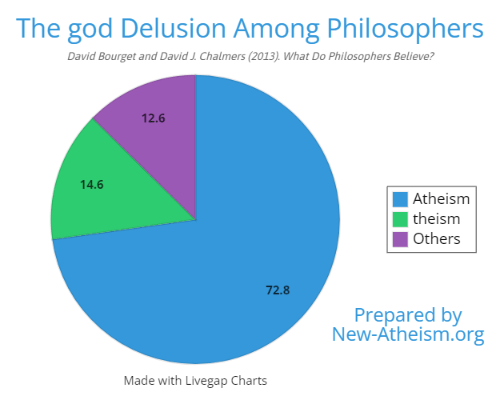
We have looked at IQ and Education levels (I skipped scientists since they are well known), now let us proceed into how many percentage of philosophers has fallen into the god delusion. There are 2 studies that include it as well. The first one was by Bourget and Chalmers, who has sent survey to 1972 members from (as they say) 99 leading philosophy departments of philosophy, 89 of which was PHD-granting department. Only 931 of them completed the survey and Here is the result on the god delusion issue:
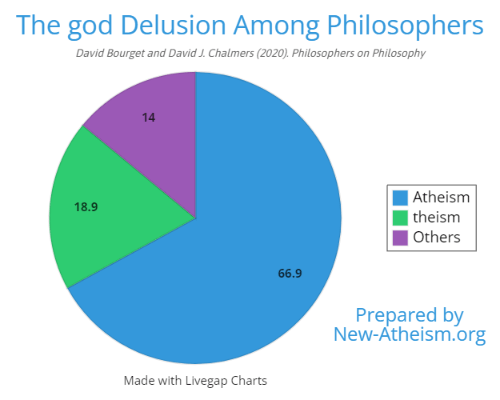
Same authors held similar survey with a bigger pool, in 2020. This time, the professional philosophers who have successfully recuperated from theism turned out to be 66.9%. As mentioned, the pool was bigger this time. Those who were sent the survey was 1800 professionals, from a wider scope. If you want, you can just reach at the paper and read for more. There are good insights like what percentage of philosophers fall for certain idiotismas presented as “argument for the existence of god”.
Final Words
Here, we do not propose any kind of conclusion like “this group is intrinsically more intelligent” or vice versa. We just list and exhibit some of the works done on this topic. The conclusions are on you, up to you – whatever you derive from it.
REFERENCES:
- https://www.pewresearch.org/religion/2010/09/28/u-s-religious-knowledge-survey/
- https://www.pewresearch.org/religion/2021/01/14/measuring-religion-in-pew-research-centers-american-trends-panel/
- https://www.census.gov/newsroom/press-releases/2022/educational-attainment.html#:~:text=The%20percentage%20of%20the%20population,from%2030.4%25%20to%2037.9%25.
- https://www.pewresearch.org/religion/religious-landscape-study/educational-distribution/college/
- https://www.pewresearch.org/religion/2017/04/26/in-america-does-more-education-equal-less-religion/
- Dürlinger F, Pietschnig J (2022) Meta-analyzing intelligence and religiosity associations: Evidence from the multiverse. PLoS ONE 17(2): e0262699. https://doi.org/10.1371/journal.pone.0262699 https://journals.plos.org/plosone/article?id=10.1371/journal.pone.0262699
- Lynn, Richard; John Harvey; Helmuth Nyborg (2009). “Average intelligence predicts atheism rates across 137 nations”. Intelligence. 37: 11–15. doi:10.1016/j.intell.2008.03.004.
 New Atheism
Leave a comment